
Integrable Systems
Exact hard-rod dynamics
A canonical quantum fluid model is solved exactly, revealing universal correlation patterns governed by Gaussian random-matrix ensembles.
OG MP
MP
Physical Review LettersMPThe London Institute’s papers are the official record of our discoveries. They allow others to build on and apply our work. Each one is the result of many months of research, so we strive to make them clear, inspiring and beautiful, and publish them in leading journals.
A canonical quantum fluid model is solved exactly, revealing universal correlation patterns governed by Gaussian random-matrix ensembles.
MP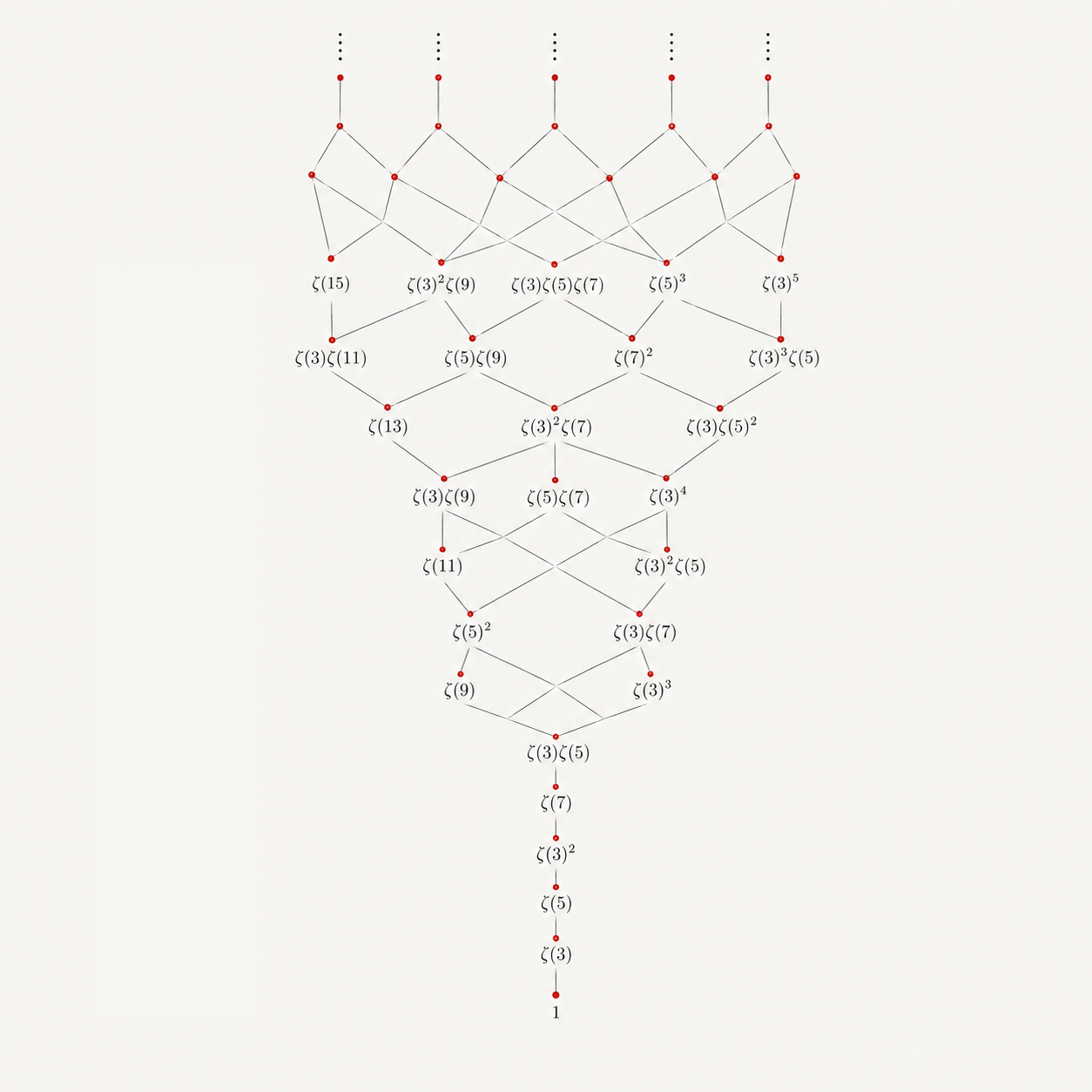
The principle of maximal transcendentality is proved to all orders for the vacuum energy of a strongly interacting quantum field theory.

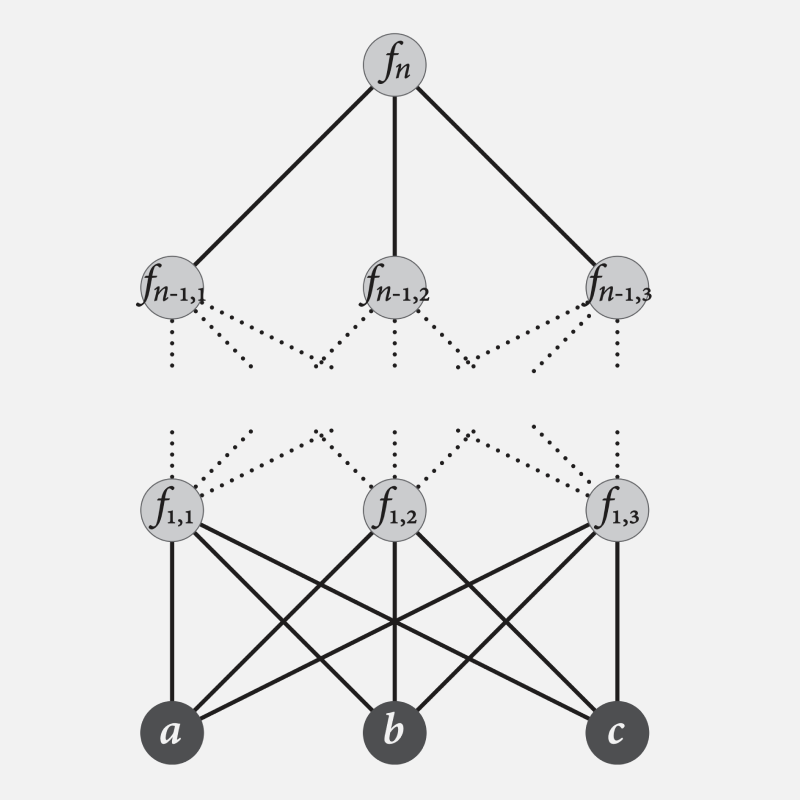
The output distribution of a deep-layered machine with random logics exhibits a critical network depth, at which it is maximally biased.


Time-optimal control of large quantum systems is computed efficiently by applying boundary conditions to a brachistochrone–Lax framework.
 KCMG
KCMGWe use the quantum brachistochrone method to design an optimal control strategy for the fastest quantum state transfer in long qubit chains.
Classical Kerr amplitudes for rotating black holes are derived using insights from recent work in massive higher-spin quantum field theory.
The first exact solution for the vacuum state of an asymptotically free QFT in a general external field found for the Principal Chiral Model.
Surprisingly, the number of attractors in the critical Kauffman model with connectivity one grows exponentially with the size of the network.
Effective field theories for Kerr black holes, showing the 3-point Kerr amplitudes are uniquely predicted using higher-spin gauge symmetry.
The ability of deep neural networks to generalize can be unraveled using path integral methods to compute their typical Boolean functions.
With inspiration from Maxwell’s classic thought experiment, it is possible to extract macroscopic work from microscopic measurements of photons.
When networks come under attack, a repairable architecture is superior to, and globally distinct from, an architecture that is robust.
The transition from solid to hollow beams changes the scaling of stability versus loading analogously to increasing the hierarchical order by one.