
Statistical physics
An AI phase change
Weight pruning uncovers critical behaviour in deep neural networks with a sharp transition from functional cooperation to disordered failure.
YH GC
GC DP
DP
ArXivGCDPThe London Institute’s papers are the official record of our discoveries. They allow others to build on and apply our work. Each one is the result of many months of research, so we strive to make them clear, inspiring and beautiful, and publish them in leading journals.
Weight pruning uncovers critical behaviour in deep neural networks with a sharp transition from functional cooperation to disordered failure.
GCDP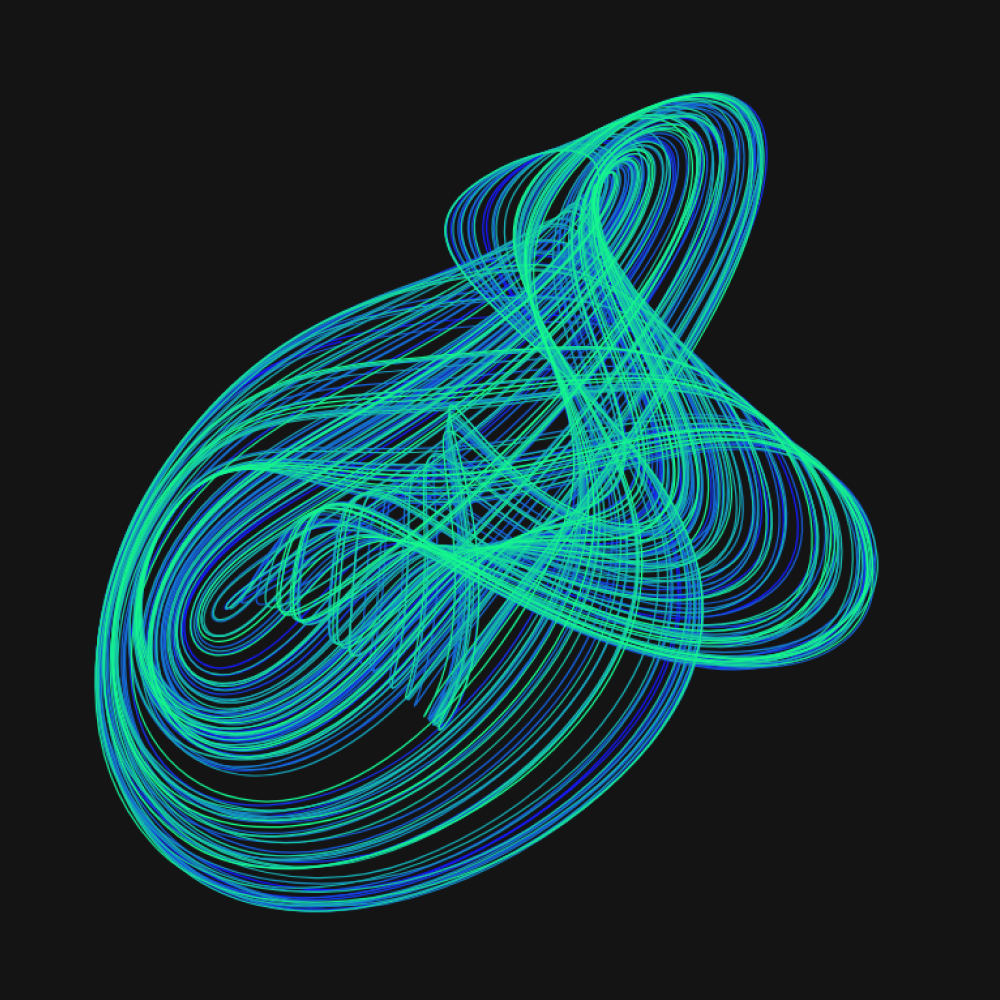
Balancing memory from linear components with nonlinearities from memristors optimises the computational capacity of electronic reservoirs.
 FC
FC AK
AK
Scale-invariant plant clusters explain the ability for a diverse range of plant species to coexist in ecosystems such as Barra Colorado.
PVTG
Exact methods supersede approximations used in high-dimensional linear regression to find correlations in statistical physics problems.
 FA
FA FLMSAC
Networks where risky banks are mostly exposed to other risky banks have higher levels of systemic risk than those with stable bank interactions.
A phase transition creates the geometry of the continuum from discrete space, but it needs disorder if it is to have the right metric.
One-shot analogs of fluctuation-theorem results help unify these two approaches for small-scale, nonequilibrium statistical physics.
Statistical mechanics concepts reconstruct connections between financial institutions and the stock market, despite limited data disclosure.
A new algorithm unveils complicated structures in the bipartite mapping between countries and products of the international trade network.
The spectral density of graph ensembles provides an exact solution to the graph partitioning problem and helps detect community structure.
Exact equations of motion provide an analytical description of the evolution and relaxation properties of complex memristive circuits.
Compact heat exchangers can be designed to run at low power if the exchange is concentrated in a crumpled surface fed by a fractal network.
An extension of the Kelly criterion maximises the growth rate of multiplicative stochastic processes when limited resources are available.
A new tool derived from information theory quantitatively identifies trees, hierarchies and community structures within complex networks.
Analysis of the hyperbolicity of real-world networks distinguishes between those which are aristocratic and those which are democratic.
Fractal structures need very little mass to support a load; but for current designs, this makes them vulnerable to manufacturing errors.
The most efficient load-bearing fractals are designed as big structures under gentle loads, a common situation in aerospace applications.
A statistical procedure identifies dominant edges within weighted networks to determine whether a network has reached its steady state.
Unbiased randomisation processes generate sophisticated synthetic networks for modelling and testing the properties of real-world networks.
The information needed to self-assemble a structure quantifies its modularity and explains the prevalence of certain structures over others.
Techniques from random sphere packing predict the dimension of the Apollonian gasket, a fractal made up of non-overlapping hyperspheres.